Wednesday, 5 February 2014

Alice Creed Opening - Gemma


Alice creed is the most chilling thriller opening I have looked at as immediately it follows the stereotypical aspect of the audience sitting on the edge of their seats. A non-diegetic soundtrack is instantly chilling and builds suspense, jump cuts are quickly used at a fast pace to compliment the suspense from a tracking side shot of cars parked in a line to then a forward tracking motion past the cars, this creates a creepy atmosphere for the audience. A medium shot is used to show a man keeping watch while another man behind him is trying to break into a van. A medium close up is then used to show us the same image of the man trying to get into the van which shows the audience clearer what the man is attempting to do.


The scene then changes via a cut and a tracking shot is used slightly to show the second man behind a car which we can see him through between the parts from behind the car taking the number plate off the van.


The scene again changes to a close up of the men’s feet from behind walking in the shops with a trolley in front of them using a tracking shot, the camera then switches to the front of the trolley and a close up of the trolley wheel is it the centre of the screen, the wheel is wobbling which suggests all is not well. Close ups of the men are then shown in the shops getting props such as a saw, a drill and some rope, all of which suggest danger and creates a chilling mood for the audience.


The scene is then changed by a simple cut into an empty room, the focus of this is the door which must represent meaning as it is the focus regularly , the camera is in a medium shot position and slowly tracks in towards the door, this is then disrupted by the men walking through it, the diegetic sounds of staples are emphasised in post-production to enhance the sound and make them more sharp. This creates an unsettling mood for the audience.


 The men seem to be working symmetrically as everything seems to be repetitive, a big close up is used to emphasise the curtains being pulled off their hooks. The lighting is dramatically changed when the characters place wooden boards in the window frame which restricts the lights and makes the setting look more scary. Close ups again are used to show the men bolting the doors with locks and ensuring they are secure, the scene again cuts to inside the van where the men are stapling plastic in the back of the van which is shown in a medium/ long shot which allows the audience to see what is happening.  The audience by this point are sitting on the edge of their seats and want to know what has happened 5 minutes into the film. This mysterious mood in the sequence is complimented by the fact that the men aren’t saying a word to each other so no dialogue is being used. This creates even more suspense and a creepy mood to the scenes.


The men’s costumes in the final scene is black but looking smart with a tie and white shirt on, black itself can be represented to be a symbol of danger, this is emphasised by the close up used to show the props in a line such as a balaclava, a gun, a knife, a gag and handcuffs. The ending shot is a close up of the man’s hands in his black leather gloves tapping the steering wheel. Finally a non-diegetic sound of ticking is used throughout the whole sequence which changes pace in sync with what is being visually shown, the ticking creates a creepy vibe throughout the whole sequence which is complimented by all of the close ups used.

Lovely Bones Opening - Gemma


The opening of lovely bones doesn’t follow a typical thriller genre. The opening shot is a long shot of a young girl which allows the audience to see where the shot is taking place, the non-diegetic sound track that accompanies this is soft and includes a piano playing, the character is a young female with blonde hair and is wearing a colourful costume and the colours in all the opening scenes are warm tones, the camera work is soft and gentle in the first scene as it firstly zooms out from a snow globe which is a nice object and just before the titles are displayed on the screen the camera work then zooms back into this object, this suggests there is going to be meaning of this object which automatically makes the audience question what.


The scene then changes to a bedroom setting with the mum and dad characters in bed, this two shot leads into a good way of passing time because as the mum stretches across to turn the light off the medium close up shot of her doing this allows the audience to see a picture of the young girl (their child) beside the lamp, as the light turns off the screen is left black, the light is then turned back on but many years have now passed as the medium close up of the mums hand is now accompanied by a picture of their teenage daughter, this tells the audience time has passed without actually having to physically tell them through showing them years or by using narration.

A hand held camera is then used to create a more  natural feel in the following scene as the now teenage character prances around her room with a camera which she takes many pictures of herself with, close ups are used to show the girl taking the photos but really she is holding the camera herself. The pace of the scene is fast and upbeat which is complimented by the non-diegetic soundtrack, an off-screen narration is also used throughout the sequence of the girl talking, this adds a slight eerie feel to the scenes as her voice is slow and breathy.


The ending narration is powerful as the girl quotes, “before it was all gone” this makes the audience question what is meant by this quote especially as it is said within the first 5 minutes of the film opening and what it might lead to.

Silence of the Lambs Opening - Gemma


In the opening of Silence of the lambs we are immediately introduced to a non-diegetic soundtrack which creates a creepy mood, this is complimented by the establishing shot via mise en scene setting of the woods which then tilts down to focus on the character running towards the camera. The lighting of the setting is eerie as it is a fogging dull light suggesting possibly an early morning in the woods. The female’s diegetic heavy breathing creates an atmosphere as it sounds unnerving especially with the non-diegetic soundtrack still playing in the background. A medium close up is used to focus in closer to the characters face and we see her looking around still breathing heavily. A tracking shot is then used from behind the character in a medium shot which gives the impression she is being followed, this then changes to an extreme long shot so the surroundings are beginning to be shown in the woods.  The camera then switches to the front of the character into a close up which shows her facial expressions. 


The females costume is a tracksuit and she is not wearing any makeup, her hair is tied back and she looks sweaty. The lighting behind the female is even darker and foggier than before which creates a tense atmosphere for the audience. As the non-diegetic soundtrack builds in tension the pace of the camera work becomes quicker which is complimented by a medium shot sideways of the characters body running from behind the trees which gives the impression that she is being watched, this camera shot is then replaced by a close up of the females feet running with the diegetic sound of the leaves crunching under her feet. 


The following medium shot from behind the character is still running but the lighting is a lot brighter which appears to be from the sun, this softens the mood of the scene and the non diegetic soundtrack complies with this as it too softens and becomes a more relaxing soundtrack. The scene is interrupted by diegetic dialogue of a man who breaks the sequence, at this point a two shot is portrayed and it is shown to the audience that the character is not in danger, the male characters costume is again a gym uniform and he is wearing an FBI cap which shows he’s important.  

The scene then changes dramatically  as we know longer see a dark creepy setting but a light busy one as the other people in the scene are all busy practising and their costumes are all black, this does represent a thriller as the dark colours signify danger. Jump cuts are used between shots to change settings and pass time throughout the sequence, a hand held camera is also used in aspects of the opening to create the scary mood to the woods.

Usual Suspect Opening - Gemma


In the opening of Usual Suspects the lighting is the first aspect I was drawn to as it is dark and its only lit by little light mainly from the matches that the character has lit. The close up of the matches alight suggest danger which is complemented by the sharp sound of them being lit. A non-diegetic soundtrack is used over the visual content which builds uncertainty for the audience. Diegetic sounds such as water dripping is heard, the repetitive dripping is unnerving for the audience as it’s frequent and loud.


A second male character is introduced to us in the shadows which automatically creates a frightening mood as we never see the characters face, diegetic footsteps are heard loudly from this character and his diegetic voice is scary alone due to the husky mysterious tone of it. A high angle is used looking down on the character from a point of view shot from the creepy man, this gives the impression the man is more superior and has power over the first character.


The props in the sequence represent threat as they include fire, smoke and a gun. A close up is used of the gun pointing into the camera lens and cuts are used to change location. The diegetic off-screen sound of gun shots are heard but not visually seen by the audience. The soundtrack continues to build suspense for the audience and a fade is then used to change location. The whole sequence contains a good use of continuity editing as It all flows well together. This is a fine example of a non-chronological ordered film as the ending of the film has been shown first.

Thriller Openings- Hannah

The Exorcist
  • Title sequence- Red writing on top of black background, the edit is also slow which creates a suspense, this highlights conventions of a thriller genre.
  • Sun rises from Black and White to Colour. highlighting danger coming. 
  • The brightness of the scene does not fit with the usual stereotype of a thriller.
  • Birds eye view - typical thriller - enhances the idea of someone watching over the scene.

Sound

  • Strings
  • Eary
  • Chanting in the background which fits in with the background music.


Silence of the lambs

  • The tracking shot of the woman running is typical of thriller genre, the shot creates suspense and idea of someone  following her.
  • The lighting  of the scene is very dull, the use of smoke when the woman is running highlights mystery.
  • The setting- woods - danger
  • Long shot of woman running- creates uncertainty and makes the woman look venerable.
    The woman s clothing is very casual, hair up and sweat on her jumper.

Sound

  •  The steady background music continues throughout the opening to create suspense
  • when there is a long shot of the woman the music suddenly changes and stops when a character appears suddenly. This also reinforces the fear of the character.
  • Diegetic sound from the woman and man dialogue.


Seven


  • The lighting of the opening scene of Seven uses a lot of shadow, this is a common convention of a thriller as it creates a mystery.
  • Fast passed edits
  • Narrative-Antagonist view
  • overlapping edit of pen shows time going past
  • red colour used to show connotations of blood, pain or danger
  • shadow of the hand creates suspense
  • close up of words within the book is very effective in this opening as it outlines certain danger that might occur within the movie for example: sexual has been highlighted in the book twice to enhance the danger and allows the viewer to study why they are highlighting certain words.


Drive
  • Birds eye view of city
  • Overlapping edit of the city and the male character in the car, gives a smoother edit
  • Over the shoulder edit of male character reinforces someone watching, creates suspense.
  • Point of view shot of man driving
  • The lighting of the scene where the man is walking to the hotel is very dark but has one high light which is the lift.
  • When the man is in the hotel his shadow is very obvious, the definite shadow of the character creates suspense, the use of shadow in thriller films.


All four thriller openings have similarities, the way they create the sense of suspense reinforces the genre of thriller. The opening for the thriller film Drive is very dark and mysterious, the shadow created has reinforced the sense of 'mystery' this is very similar to the shadow used in Seven, both films use light and shadow to indicate that something is about to take place or distinguish characters for example: in Drive they have used the main character (Ryan Gosling) in a dark light, this to a viewer portrays the character as evil. Dark lighting has also been used in Silence of the Lambs, the dark lighting has created a thrilling atmosphere as the woman runs through the forest on her own, the dull dark smoke in the scene also reinforces the look of hazard appearing. Unlike normal thriller openings The Exorcist is very different, the lighting is very high light and shows a contrast from the opening credits (black and red) to the warm orange colours of the sun rise.

Tuesday, 4 February 2014

4 Thriller Openings - Katie


This opening scene is from Inception. Immediately you can distinguish it as a thriller due to the non-diegetic sound. It is a very low type of music - almost like a heart beat, which instantly pulls you into the movie. There is very dark lighting which is also another aspect of a thriller.


I wouldn't necessarily class 'Now You See Me' as a typical thriller at first. But the opening scene highlights aspects of it being a thriller. The first shot pulls the audience straight in and, again, is set in very dark lighting with non-diegetic sound.


This opening thriller scene is from 'The Dark Knight Rises'. Immediately it shows a mysterious setting, which is an aspect of a thriller. And then it swiftly moves onto a relatively violent scene in a plane. This scene mainly consists of diegetic sound as opposed to non-diegetic.


Because of the dramatic, creepy music I thought this movie, 'The Sixth Sense' was going to be a horror. But it was actually a thriller. The opening scene didn't have the same sort of feel that a horror would. Instead it was a lot more creepy and tense then a horror is. The non-diegetic sound had a freaky tone to it, due to a of string sounds.


Friday, 31 January 2014

TYPES OF LIGHTING


3 POINT LIGHTING


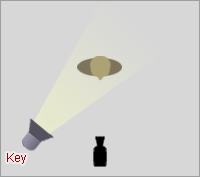
Key Light

Key Light

This is the main light. It is usually the strongest and has the most influence on the look of the scene. 
It is placed to one side of the camera/subject so that this side is well lit 
and the other side has some shadow.

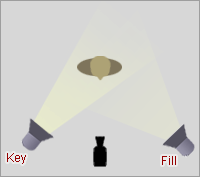
Key and Fill

Fill Light

This is the secondary light and is placed on the opposite side of the key light.
 It is used to fill the shadows created by the key.
The fill will usually be softer and less bright than the key.
To acheive this, you could move the light further away or use some spun.
You might also want to set the fill light to more of a flood than the key.
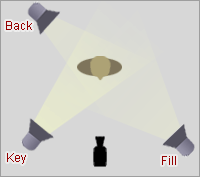
Key, Fill and Back

Back Light

The back light is placed behind the subject and lights it from the rear.
Rather than providing direct lighting (like the key and fill), its purpose
is to provide definition and subtle highlights around the subject's outlines.
 This helps separate the subject from the background and provide a three-dimensional look.